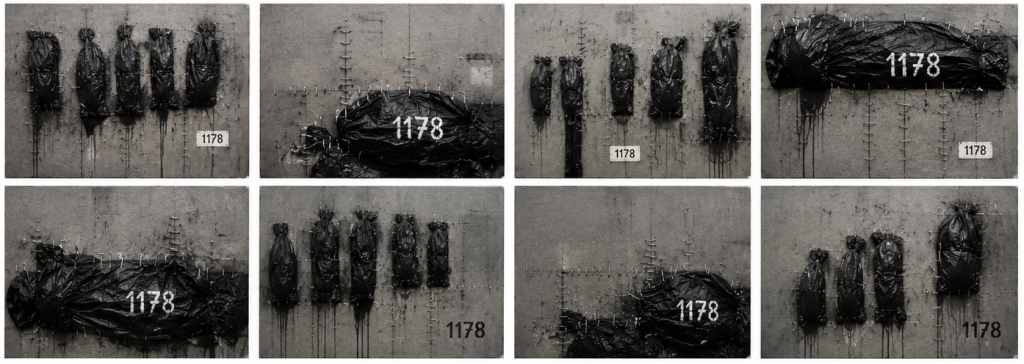
This mixed-media work was created in response to the people killed during the January 2026 violence in Iran and to the ways images of their bodies, names, numbers, and traces circulated through digital space. The work begins from the disturbing presence of black body covers, anonymous numbers, and fragmented images shared online. These images did not remain only as documentation of death. As they moved across social media, they became part of a collective struggle over recognition, grief, and political truth.
In this work, black plastic, staples, grey texture, stains, and repeated body-like forms are used to think through the material and digital life of suppressed bodies. The black plastic refers to covering, containment, disposal, and the forced reduction of the body to an anonymous object. The staples suggest both attachment and violence: they hold the forms in place, but they also pierce, fix, and immobilize them. The grey ground evokes a damaged surface: a wall, a floor, a public site, or an unstable archive on which traces of death are registered.
The number 1178 is not treated simply as a label. It stands for the bureaucratic and visual transformation of a dead body into a countable, searchable, and shareable sign. In the digital circulation of violence, numbers can both erase and preserve. They can reduce a life to data, but they can also become a point around which grief, anger, and public memory gather. The number becomes a fragile index of a person whose name, body, and story may be withheld, obscured, or violently managed.
This work is also an attempt to think about social media as a contemporary mourning space. In the aftermath of political violence, images of the dead often move faster than official recognition. Families, witnesses, activists, and ordinary users circulate fragments: a body, a number, a name, a post, a screenshot, a voice, a caption. These fragments produce a different kind of public archive—unstable, emotional, vulnerable, and collectively assembled. Digital circulation becomes one of the ways through which the dead continue to make claims on the living.
As part of my broader research on the agency of dead bodies and political mourning in Iran, this piece explores how suppressed bodies enter public life after death through both material and digital forms. The work does not attempt to reproduce the original images directly. Instead, it translates their force into texture, repetition, fixation, and surface. It asks how a body becomes a number, how a number becomes evidence, and how evidence becomes a site of mourning and resistance.
At the intersection of anthropology and mixed-media art, this piece treats visual material not only as documentation, but as a way of thinking. Through plastic, metal, texture, and number, it examines how political death is hidden, circulated, counted, and remembered.
January 2026 / Iran
Mixed-media response to political death and digital circulation
Black plastic, staples, acrylic, texture, stains, and numbered forms on canvas