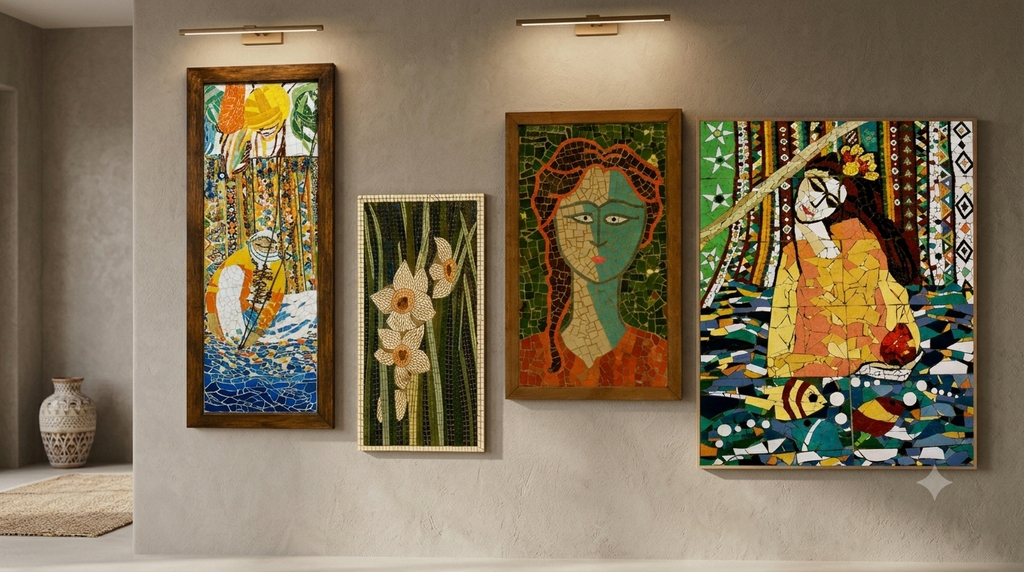
My path into anthropology began through art. Before I entered the social sciences, I was trained as an artist, with an early focus on design and visual-material practice. My undergraduate education gave me a broad and technically grounded formation in making, drawing, painting, woodworking, sculpture, installation, and object design. This training was not limited to the production of images. It was also an education in material, surface, form, weight, texture, proportion, and the relation between objects and space.
During my undergraduate studies, I worked extensively with wood and learned several traditional and technical methods, including marquetry, khatam, woodcarving, sculpture, box-making, frame-making, and object construction. I was also trained in aspects of industrial design, including the design and fabrication of tools, frames, boxes, and display structures. I became interested in geometric forms associated with Islamic architecture, especially girih and lattice-based compositions, where repetition, precision, structure, and ornament produce both visual and spatial effects. Alongside these practices, I also worked with resin and other material techniques that allowed me to think more experimentally about surface, transparency, layering, and preservation.
My painting and drawing practice developed in parallel with this material training. I worked with colored pencil, chalk pastel, graphite, different pencil-based techniques, and ink. Chalk pastel became especially important in my early practice because of its softness, density, and capacity to hold both fragility and intensity on the surface. I was particularly interested in portraiture, the human face, texture, and the expressive force of line and color. This interest led to my solo painting exhibition in Kerman, titled Portraits, in which I primarily used chalk pastel.
Installation art was another important part of my artistic formation. During my undergraduate studies, I created two installation-based projects that combined sculpture, music, spatial arrangement, and conceptual research. One installation engaged Mesopotamian mythologies and the agency of great goddesses. Through sculpture and spatial composition, I explored how female divine figures could be imagined not simply as mythological subjects, but as agents whose presence, form, and material arrangement shaped the viewer’s encounter with the work.
The second installation was more directly connected to death, memory, gender, and Iranian culture. I constructed six wooden tombstones dedicated to six influential women in Iranian cultural history. The work combined carved or constructed wooden forms with music and installation-based presentation. Looking back, this project was one of my earliest attempts to think about the relationship between the dead, material objects, commemoration, gendered memory, and public recognition. Even before I had the full anthropological language for these questions, I was already working with themes that later became central to my academic research: tombstones, memory, gender, material presence, and the agency of commemorative forms.
This artistic background profoundly shaped the way I later approached anthropology. Art trained me to look slowly and materially. It taught me to notice how objects are made, how surfaces carry traces, how forms organize attention, and how images and materials produce encounters. When I later began studying cemeteries, tombstones, martyr graves, photographs, coffins, portraits, ritual objects, and memorial spaces, I did not approach them only as symbolic materials or cultural data. I approached them as visual and material forms that act within social life. My artistic training allowed me to see how material cultures can shape memory, produce obligation, organize mourning, and mediate relations between the living and the dead.
In my undergraduate and master’s research, this connection between art and anthropology became more explicit. I became increasingly interested in the visual elements of cemeteries, especially martyr cemeteries, and in the material culture that surrounds death and commemoration. I studied tombstones, inscriptions, portraits, symbols, colors, spatial arrangements, objects placed on graves, and the aesthetic organization of funerary spaces. These materials allowed me to bring together visual analysis, semiotics, material culture, and anthropological questions about death, memory, religion, gender, and political meaning.
Today, this visual-material orientation continues to shape both my scholarship and my creative practice. My doctoral research on the agency of dead bodies in contemporary Iran is grounded not only in ethnographic fieldwork, but also in close attention to bodies, images, textures, graves, objects, spatial arrangements, and ritual forms. Alongside academic writing, I continue to develop mixed-media work that brings together photography, painting, texture, collage, and material experimentation. I am also interested in filmmaking and documentary practice as ways of extending anthropological thinking beyond written scholarship.