Digital Mourning and the Afterlife of Political Death

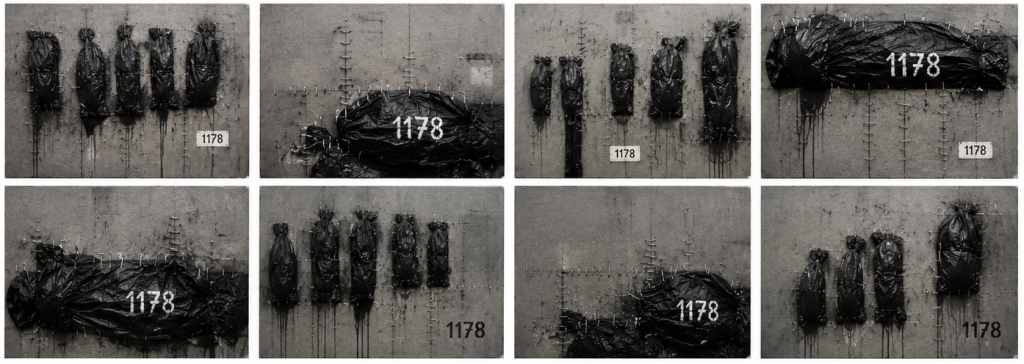
This mixed-media work was created in response to the people killed during the January 2026 violence in Iran and to the ways images of their bodies, names, numbers, and traces circulated through digital space. The work begins from the disturbing presence of black body covers, anonymous numbers, and fragmented images shared online. These images did not remain only as documentation of death. As they moved across social media, they became part of a collective struggle over recognition, grief, and political truth.

In this work, black plastic, staples, grey texture, stains, and repeated body-like forms are used to think through the material and digital life of suppressed bodies. The black plastic refers to covering, containment, disposal, and the forced reduction of the body to an anonymous object. The staples suggest both attachment and violence: they hold the forms in place, but they also pierce, fix, and immobilize them. The grey ground evokes a damaged surface: a wall, a floor, a public site, or an unstable archive on which traces of death are registered.

The number 1178 is not treated simply as a label. It stands for the bureaucratic and visual transformation of a dead body into a countable, searchable, and shareable sign. In the digital circulation of violence, numbers can both erase and preserve. They can reduce a life to data, but they can also become a point around which grief, anger, and public memory gather. The number becomes a fragile index of a person whose name, body, and story may be withheld, obscured, or violently managed.

This work is also an attempt to think about social media as a contemporary mourning space. In the aftermath of political violence, images of the dead often move faster than official recognition. Families, witnesses, activists, and ordinary users circulate fragments: a body, a number, a name, a post, a screenshot, a voice, a caption. These fragments produce a different kind of public archive—unstable, emotional, vulnerable, and collectively assembled. Digital circulation becomes one of the ways through which the dead continue to make claims on the living.

As part of my broader research on the agency of dead bodies and political mourning in Iran, this piece explores how suppressed bodies enter public life after death through both material and digital forms. The work does not attempt to reproduce the original images directly. Instead, it translates their force into texture, repetition, fixation, and surface. It asks how a body becomes a number, how a number becomes evidence, and how evidence becomes a site of mourning and resistance.

At the intersection of anthropology and mixed-media art, this piece treats visual material not only as documentation, but as a way of thinking. Through plastic, metal, texture, and number, it examines how political death is hidden, circulated, counted, and remembered.

January 2026 / Iran
Mixed-media response to political death and digital circulation
Black plastic, staples, acrylic, texture, stains, and numbered forms on canvas

Art, Anthropology, and Infrastructures of Martyrdom

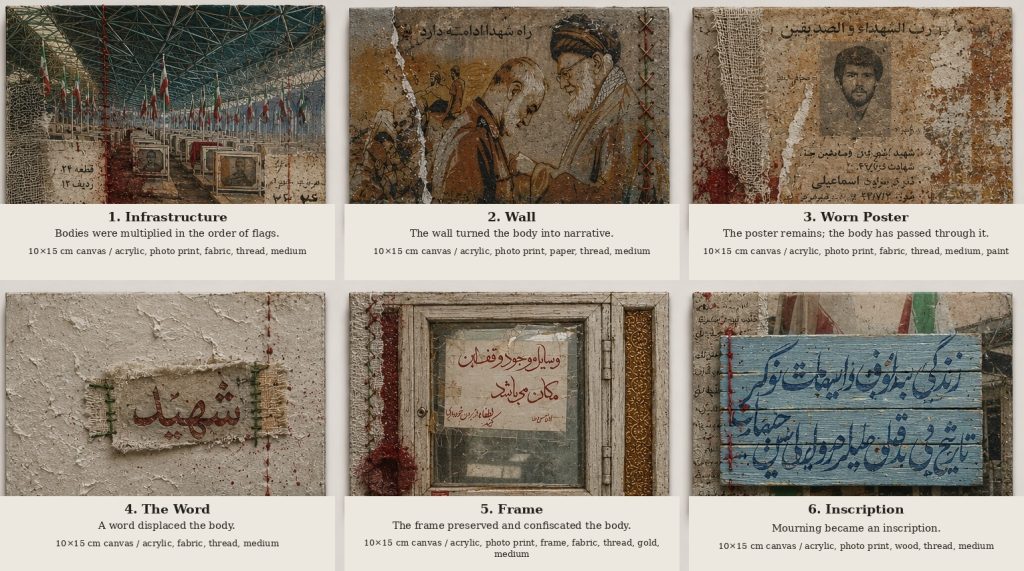
This series is based on photographs I took during my fieldwork in Iran in fall 2024 and spring 2025, in the cities of Ahvaz and Tehran. The photographs document urban spaces, walls, official signs, memorial frames, inscriptions, and sections of cemeteries, especially the martyrs’ sections.

This project is part of an ongoing attempt to bring together anthropology and visual art in order to think more carefully about political death in Iran. It is not only a finished visual series, but also a process of learning how to work with images, materials, and mixed-media techniques as part of anthropological research. Through this process, I am experimenting with how field photographs can be transformed into visual objects that carry texture, damage, repetition, inscription, and material presence.

As an anthropological project, the series approaches these images as part of a wider field of social and political life: cemeteries, city walls, portraits, flags, inscriptions, frames, ritual objects, and public memorial infrastructures. As a mixed-media art project, it works with the photographs as material fragments, layering them with texture, thread, fabric, stains, marks, paper, and written signs. The aim is not simply to illustrate death, but to explore how death is mediated, framed, touched, repeated, and made meaningful through visual and material forms.

In these images, the martyr’s body is not present only in the grave or in the portrait. Its presence extends through architecture, walls, frames, inscriptions, plaques, flags, and urban infrastructures. The city becomes a surface for preserving, repeating, and reproducing the name and image of the martyr. The cemetery, likewise, is not simply a place of burial; it is part of a visual, material, and political system that keeps the killed body within public memory.

This series is also concerned with the role of visual culture in how people come to understand political death. In Iran, martyrdom is not only a religious or political category; it is also a visual language. It is encountered through posters, murals, framed portraits, cemetery layouts, public signs, ritual objects, and repeated inscriptions. These visual forms teach people how to see the dead, how to remember them, and how to place them within larger narratives of sacrifice, legitimacy, nation, and political belonging.

By combining field photography with mixed-media interventions, this work asks what happens when ethnographic images are not treated only as documents, but also as materials to be worked through. The added textures, stitches, stains, and fragments do not attempt to reconstruct reality. Rather, they make visible the processes through which death becomes public, political, and aesthetically organized. They also allow me to think through the body, the image, and the city in ways that writing alone may not fully capture.

At the intersection of art and anthropology, this series asks how visual forms shape the social life of the dead. It treats images not only as evidence, but as active sites of interpretation and experimentation. Through this work, I am trying to understand how political death is displayed, governed, mourned, aestheticized, and made meaningful in contemporary Iran—and how visual art can open another way of thinking anthropologically about death, memory, and public life.

Fall 2024 / Spring 2025
Ahvaz and Tehran, Iran
Urban spaces, walls, memorial images, and martyrs’ cemetery sections