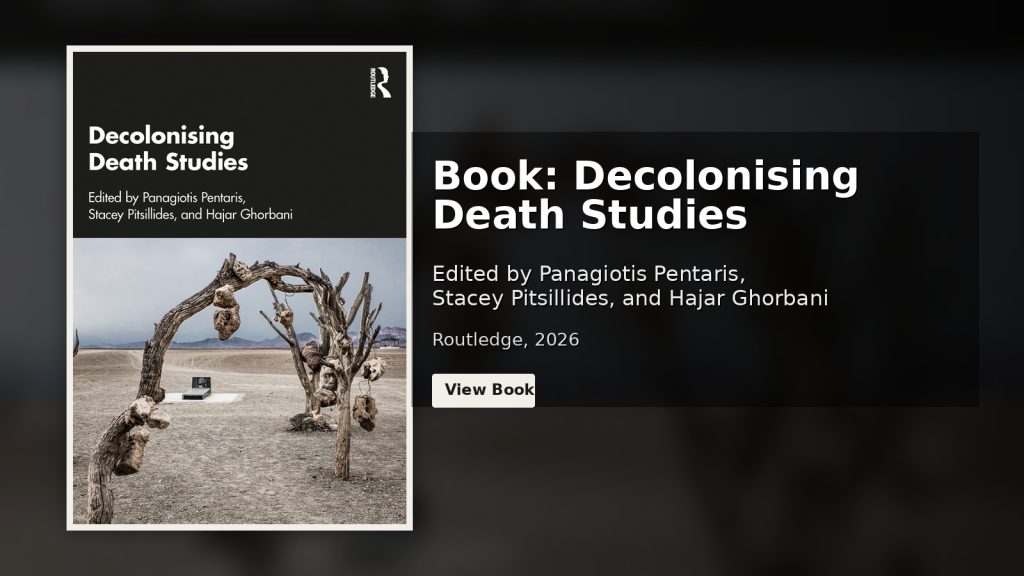
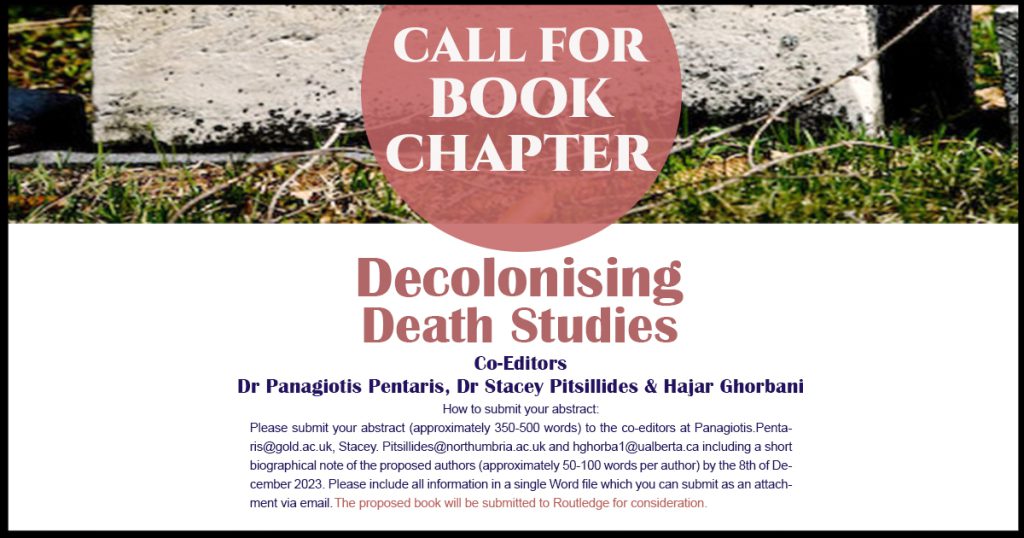
Title: Decolonising Death Studies
Co-Editors: Dr Panagiotis Pentaris, Dr Stacey Pitsillides & Hajar Ghorbani
Overview
Social and cultural factors can strongly influence how we approach death and dying, including attitudes towards death, rituals and practices surrounding death, and end-of-life care. The World Health Organization notes that understanding these factors is important for improving the quality of life and care for individuals facing life-limiting illnesses (WHO, 2021).
Hamilton et al. (2022) note that current knowledge in death studies tends to be influenced by Western views, conforming identities, specific disciplines, the English language, and a certain generation, which can limit its application to policy and practice. The authors argue that decolonising death studies requires exploring the nature of knowledge that underpins claimed expertise in this area, which has universal implications for policies, practices, theory, and research. This is not a new argument, but one which was noted in 1978 by Lofland, critiquing the happy death movement’s lack of diversity, claiming that its proponents were predominantly heteronormative, white and affluent. More contemporary research groups in death studies, like the Queer Death Studies Network (2016) and the Collective for Radical Death Studies, address this by collecting a wider body of literature in the field of death studies.
The increasing diversity and plurality of populations around the world necessitates further attention to diversifying evidence and knowledge to ensure that it effectively serves its beneficiaries (Mokhov and Pentaris, 2022). However, there is potential risk for re-colonising knowledge in this area due to the persistence of English-speaking, Western, and conforming expertise in the field that may or may not understand the connected histories of colonialism. To address this, networks of knowledge and expertise that challenge these limitations and seek to avoid the risk of re-colonisation to broaden the case of knowledge and key texts used by death studies researchers are needed. Such networks may be physical, contextual or digital, but they always lead to collective discourses that break free from the colonisation of death studies.
With that in mind, this book is looking to host the space for an interdisciplinary, international, especially from under-represented groups, dialogue which seeks to advance our exploration of both knowledge outside of the colonised and the degree of the current knowledge’s applicability in the field. Additionally, and drawing from Jansen’s (2019) thesis on the politics of knowledge focusing on the lack of postcolonial, indigenous and critical knowledge, the proposed book will become a beneficial tool for its ability to pool resources and expertise. This can help reduce gaps in the current knowledge base.
focusing on the exploration of the colonisation, re-colonisation and decolonisation of death studies – no matter the expertise of the contributors (e.g., assisted dying, AI and grief, art-based practices with dying individuals, etc.) – are welcome. The volume is particularly interested in the inclusion of minoritised voices and perspectives, in the collaboration of authors with people with lived experience, as well as the learning from different geographies and disciplines. Further, proposals linked with any of the many global issues and phenomena and how those manifest on the experiences of death, dying and bereavement are welcome. This volume will also welcome shorter forms of writing, for example: experiential essays, reflections on practice wisdom or autobiographic accounts.
The proposed book will be submitted to Routledge for consideration.
If you wish to discuss your idea about a contribution before submitting an abstract, please contact the coeditors directly.
How to submit your abstract
Please submit your abstract (approximately 350-500 words) to the co-editors at Panagiotis.Pentaris@gold.ac.uk, Stacey.Pitsillides@northumbria.ac.uk and hghorba1@ualberta.ca including a short biographical note of the proposed authors (approximately 50-100 words per author) by the 8th of December 2023. Please include all information in a single Word file which you can submit as an attachment via email.
FEEL FREE TO SHARE WITH YOUR CONTACTS