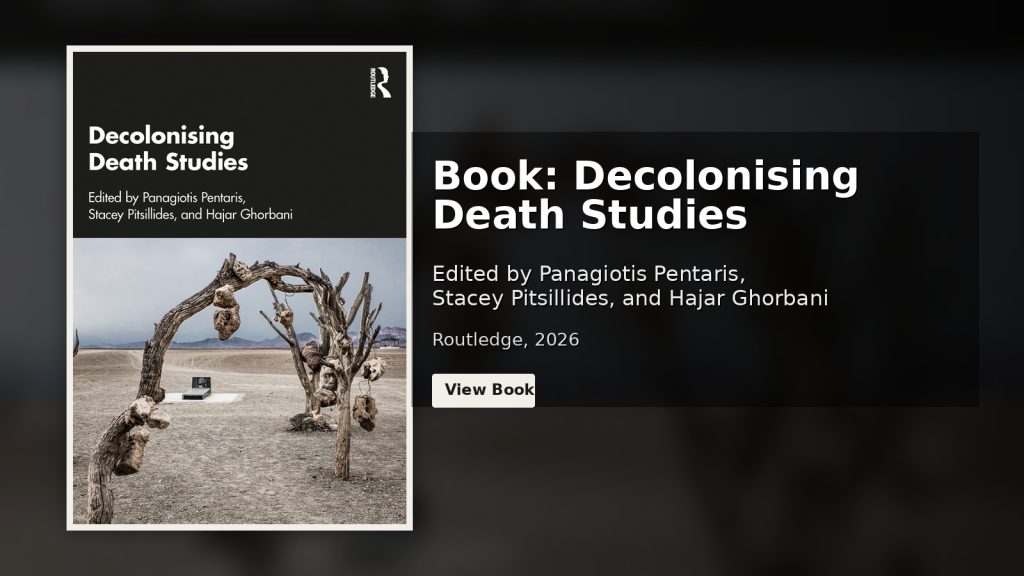
Edited by Panagiotis Pentaris, Stacey Pitsillides, and Hajar Ghorbani Routledge, 2026
Decolonising Death Studies brings together international and interdisciplinary perspectives that rethink death studies beyond primarily Western frameworks. The volume foregrounds decolonial, situated, and globally diverse approaches to death, dying, mourning, ritual, care, and end-of-life knowledge.
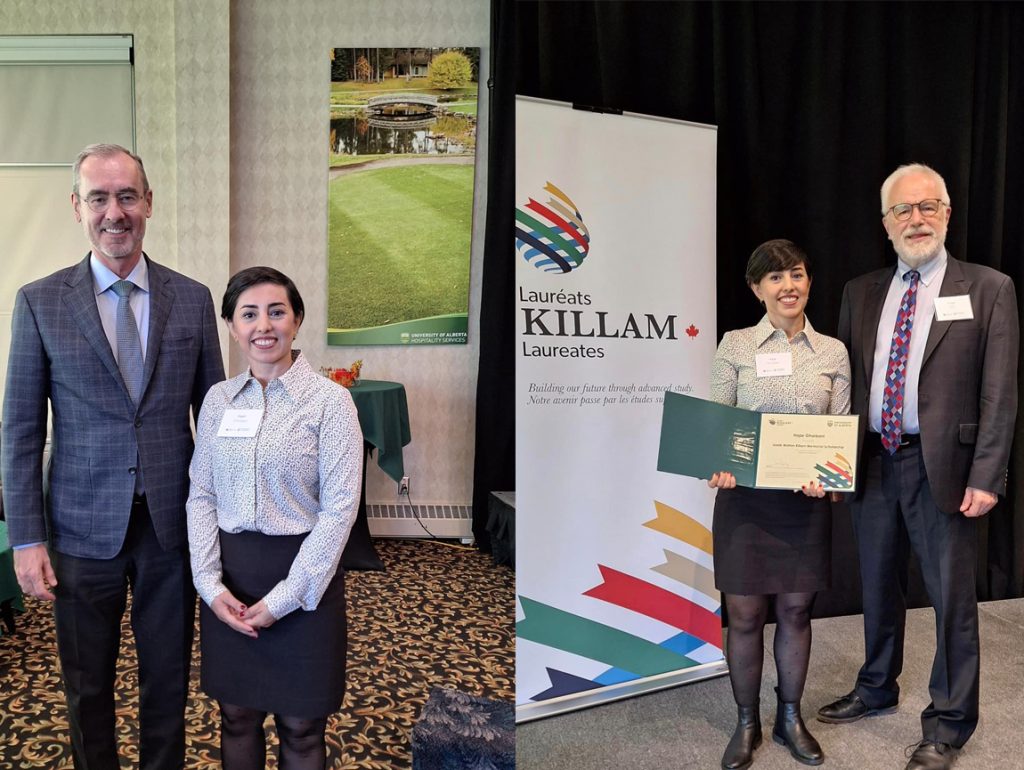
The Izaak Walton Killam Memorial Scholarships are the most prestigious graduate awards administered by the University of Alberta. They are awarded to outstanding doctoral students who, at the time of application, have completed at least one year of graduate study. Killam Scholarships are awarded for two years and include a stipend of $45,000 per year. Each award is renewable for a second year upon continued exceptional performance in a doctoral program at the University of Alberta.
Hajar Ghorbani is a sociocultural anthropology PhD student at the University of Alberta specializing in death studies. Her research centers on the intersections of death and modernity, as well as death and politics in Iran and the Middle East. She has been studying death and dying since 2011 and has conducted extensive fieldwork in Iran for six years. Hajar’s contributions to the field include published research in several journal articles and book chapters. She has also played a pivotal role in developing death studies in her country, serving as the editor of The Social Studies of Death in Iran (2020). In recognition of her expertise, Hajar Ghorbani was invited as a keynote speaker at the Center for Death and Society (CDAS) at the University of Bath, UK, in 2022. Currently, in her doctoral research project titled “Dead Bodies’ Agency and Western Politics”, she is advancing the conventional perspectives in social sciences that assume the living govern the dead. Her work explores the agency of dead bodies that affect the experience and actions of mourners and evoke memories of the past rather than serve their socio-political ends.
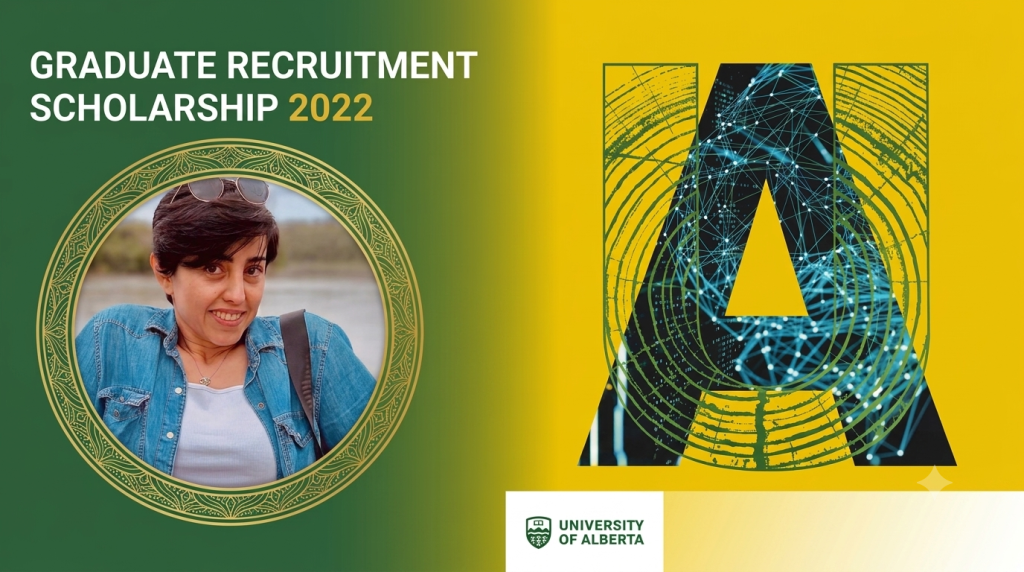
Hajar Ghorbani, a Ph.D. student of sociocultural anthropology, is the winner of University of Alberta Graduate Recruitment Scholarship in 2022.
The purpose of the Recruitment Scholarship is to recruit superior graduate students who have the potential to contribute to the University of Alberta’s community and research.
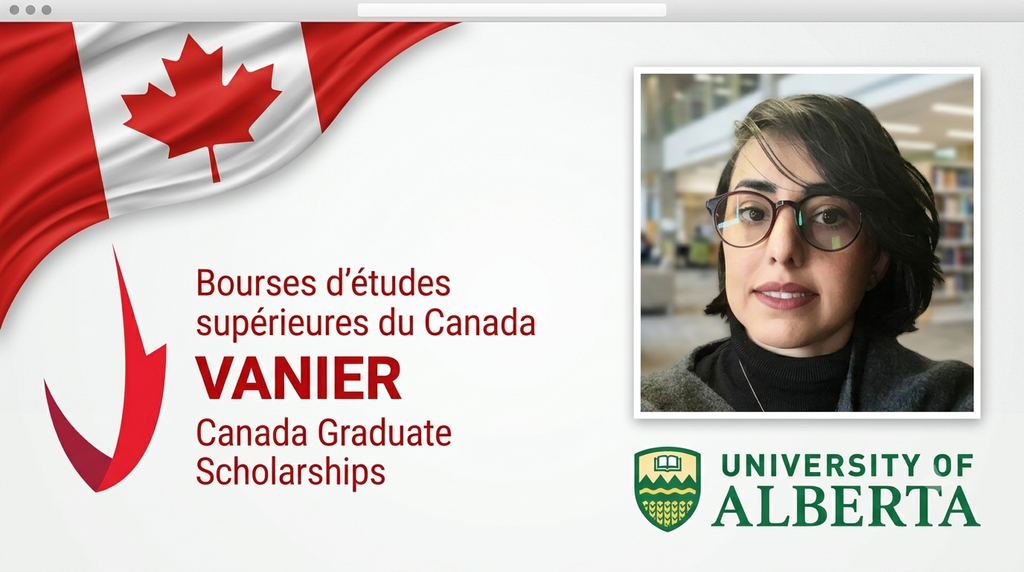
Hajar Ghorbani, a Ph.D. candidate at the University of Alberta, achieved 1st rank and received the prestigious Vanier Canada Graduate Scholarship (Vanier CGS).
Named in honor of Major-General Georges P. Vanier, the first francophone Governor General of Canada, the Vanier CGS program helps Canadian institutions attract highly qualified doctoral students. Valued for three years during doctoral studies, it considers three equally weighted selection criteria:
I was born in Shiraz, Iran, in a large family. My early path into art was shaped by both desire and resistance. Although I was deeply drawn to art, my father initially opposed my decision to attend an art school. As a result, my education took an unconventional form. For several years, I stepped outside the formal school system and used that period to explore different practices, especially drawing, painting, and martial arts. I trained in Kung Fu, participated in competitions, and continued to develop my skills in painting, particularly with chalk pastel. This period was difficult, but it also shaped my independence, discipline, and capacity for self-directed learning.
After several years, I persuaded my father to allow me to take the entrance exam for an art program. I was eventually admitted to the Islamic Art program at Isfahan University of Art. Moving from Shiraz to Isfahan was a major turning point in my life. It was not only a move from one city to another; it was my first serious encounter with a new intellectual, artistic, and urban environment. Isfahan itself became part of my education. I began to walk through the city, observe its architecture, photograph its streets and objects, and experience urban space as something that could be read, interpreted, and analyzed.
At Isfahan University of Art, I studied in the Department of Religious and Civilization Arts. The department created an unusual intellectual environment where art was not approached only as technique, beauty, or form, but also as a way of thinking about culture, history, religion, society, and meaning. Between 2009 and 2013, I encountered scholars from anthropology, sociology, philosophy, semiotics, mythology, and art history. Their courses and conversations introduced me to new ways of understanding visual and material culture.
A decisive moment came when I took a course in the anthropology of art. This course changed the way I looked at the world around me. The concept of culture became central to my thinking. I began to understand that objects, images, rituals, spaces, and everyday practices could be studied as part of wider social worlds. My artistic practice of looking, drawing, and photographing gradually became connected to anthropological observation. I was no longer only interested in how things looked, but also in what they did, what they meant, and how they organized relations between people, places, memories, and histories.
During this period, I often walked through Isfahan with my camera. One day, by chance, I came across Takht-e-Fulad, a historic cemetery in the city. The tombstones immediately caught my attention. Their forms, inscriptions, symbols, materials, and visual arrangements seemed to hold complex cultural meanings. I photographed them and later discussed the images with Jabbar Rahmani, an anthropologist in our department. He encouraged me to think of tombstones as cultural texts and suggested that I explore the anthropology of death, a field that was still relatively underdeveloped in Iran at the time.
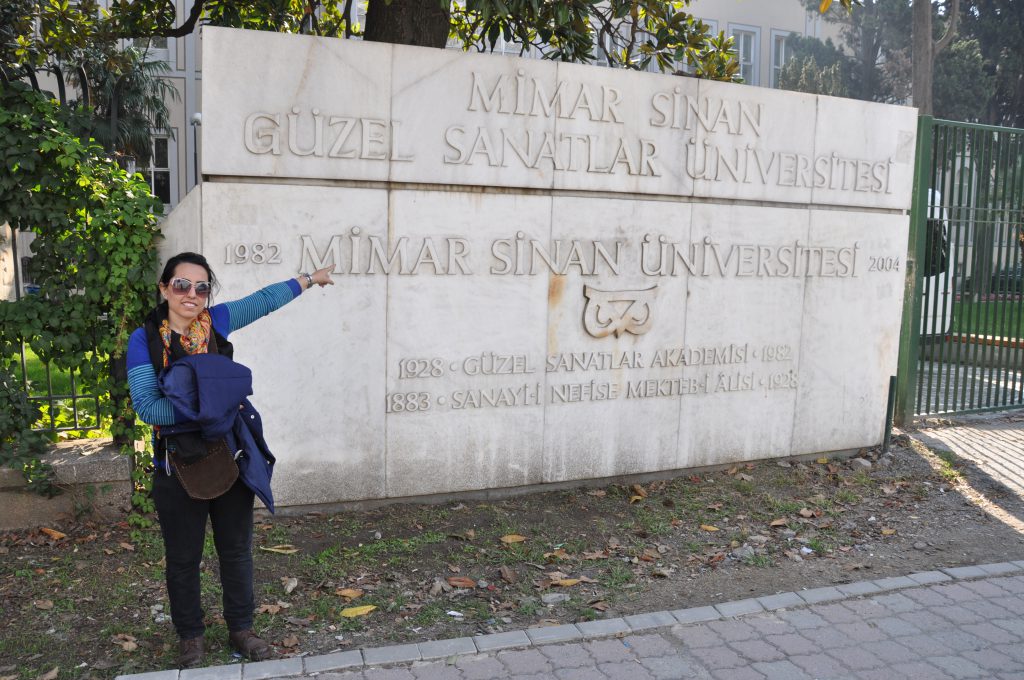
This encounter became the foundation of my undergraduate thesis, “Cultural Semiotics of Tombstone Signs in the Takht-e-Fulad Cemetery.” The project allowed me to bring together my artistic training and my emerging anthropological interests. Tombstones were no longer simply visual or decorative objects. They became material forms through which death, memory, religion, gender, class, and cultural identity could be read and interpreted. Based on this work, I later published an article and presented my research at an international conference in Turkey in 2013.
This movement from Shiraz to Isfahan, and from art to anthropology, continues to shape my work today. My research on death, cemeteries, martyrdom, mourning, and the agency of dead bodies grew out of this early encounter between visual practice and anthropological thinking. Art trained me to attend to form, texture, composition, and material presence. Anthropology gave me the conceptual tools to connect those forms to social life, ritual, memory, power, and political meaning.