Between 2024 and 2025, my ethnographic fieldwork brought me to the intimate, often unseen margins of Iran, tracing the material and spiritual rituals of death. Working at the intersection of visual art and sensory anthropology, I am continually drawn to the spaces where sorrow lingers and transforms—what I often conceptualize as the afterlives of mourning.
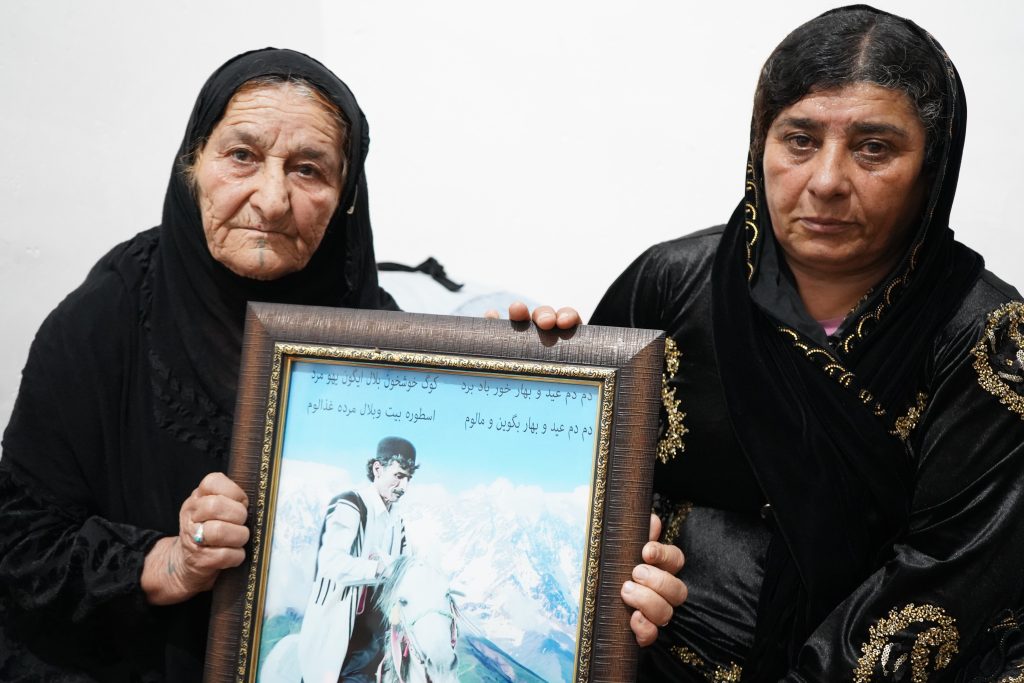
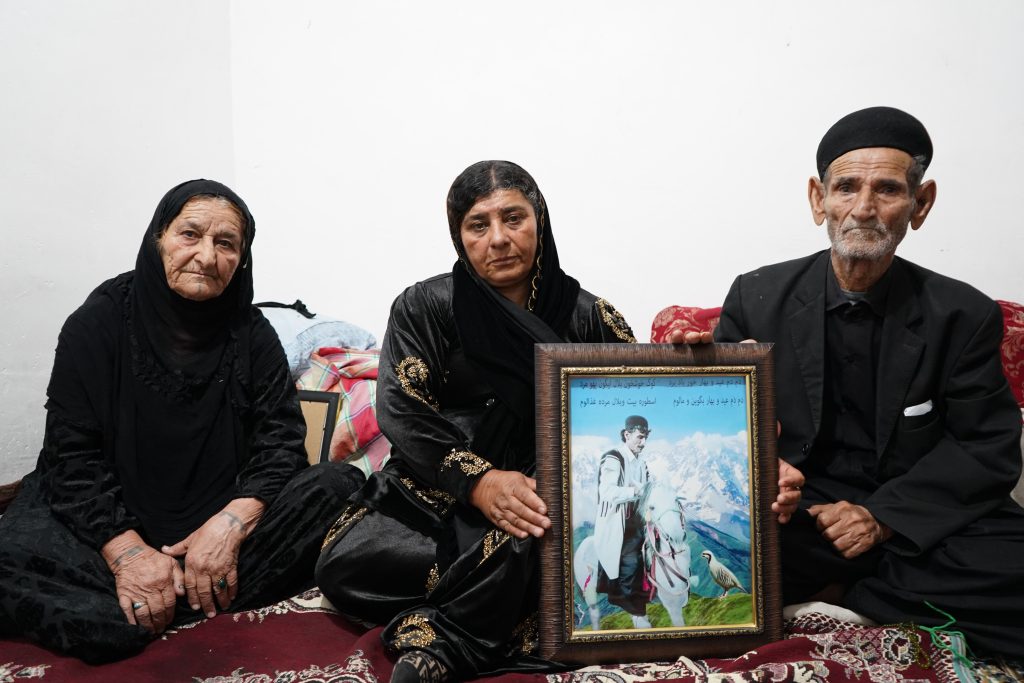
This post shares a fragment of that journey: a sensory and visual documentation of Gagriyu (گاگریو). Translating literally to “the time of crying,” Gagriyu is far more than a lamentation; it is a profound, improvised oral history. In the city of Shush, I had the privilege of documenting the Bahmaei style of this ancient practice. Through the intertwined voices of a mother and daughter, personal grief is transformed into a powerful, collective soundscape.
Women are the primary custodians of this ritual. With spontaneous, heart-rending verses, they honor the bravery, hospitality, and essence of the departed. Through a sensory ethnographic lens, we can hear how the women become living archives—their vocalizations holding the physical resilience and pain of their community.
In this short visual excerpt, the camera and microphone do not merely observe; they attempt to capture the invisible, visceral weight of loss. A brief interview contextualizes the lived realities of these women, grounding the subsequent performance. Through this documentation, we witness the traces that act—how memory is vocally, physically, and fiercely sustained by those left behind.
Videographer and Photographer: Hajar Ghorbani, Fall 2024, Shush, Iran
Installation, wood, music, and spatial arrangement, 2013
Seven Tombstones for Seven Iranian Women is an installation work I created in 2013 as part of my undergraduate artistic practice. The project consisted of seven wooden tombstones dedicated to seven Iranian women who had significant cultural influence in Iranian women’s history, memory, and cultural life.
The work brought together wood, carving, symbolic form, music, and spatial arrangement. Each tombstone was conceived not only as a commemorative object, but also as a material form through which questions of gender, memory, cultural recognition, and posthumous presence could be explored.
This installation marked an important early moment in my artistic and intellectual development. Long before my doctoral research on death, mourning, cemeteries, and the agency of dead bodies in Iran, I was already working through related questions in visual and material form. The tombstone became, for me, not simply an object of burial or remembrance, but a site where memory, gender, absence, and cultural agency could be made visible.
Looking back, this work represents one of my earliest attempts to connect art, death, material culture, and anthropology. It also anticipated many of the questions that later became central to my academic research: how the dead remain socially present, how material forms organize memory, and how commemorative objects can generate recognition, obligation, and public meaning.
Image: Wooden tombstone from Seven Tombstones for Seven Iranian Women, installation, 2013.
Sound Component
The installation was accompanied by a musical piece titled Sang-e Sabur. The piece was composed and performed by Ilia Moshtaghizadeh, a musician from Shiraz. Rather than functioning as background music, the sound component was part of the spatial and emotional structure of the installation. It shaped the viewer’s encounter with the seven wooden tombstones and deepened the work’s engagement with memory, absence, gender, and commemoration.
Audio caption:
Sang-e Sabur Composed and performed by Ilia Moshtaghizadeh Sound component for Seven Tombstones for Seven Iranian Women, 2013.
In Lor and Bakhtiari society, the tradition of funeral lamentation—known as Moyeh or Gagriv—functions as a powerful ethnographic site of oral history, communal resilience, and collective memory. Far beyond a spontaneous expression of grief, it is a highly structured, gendered ritual primarily led by senior women (Bi-Bis), who employ improvised oral poetry set to evocative melodic structures (dong-e dal). Through these performative verses, women articulate the moral economy and social virtues of their community, contextualizing the deceased’s life by exalting traits such as hospitality, bravery, and ancestral lineage for men, or virtue and domestic devotion for women. As the lead soloist introduces a verse, the surrounding assembly of women joins in a antiphonal, repetitive chorus, transforming individual sorrow into a shared cathartic experience that reinforces tribal solidarity, preserves linguistic heritage, and mediates the social disruption caused by death.
Photographer: Hajar Ghoraani, November 2024, Shushtar, Iran
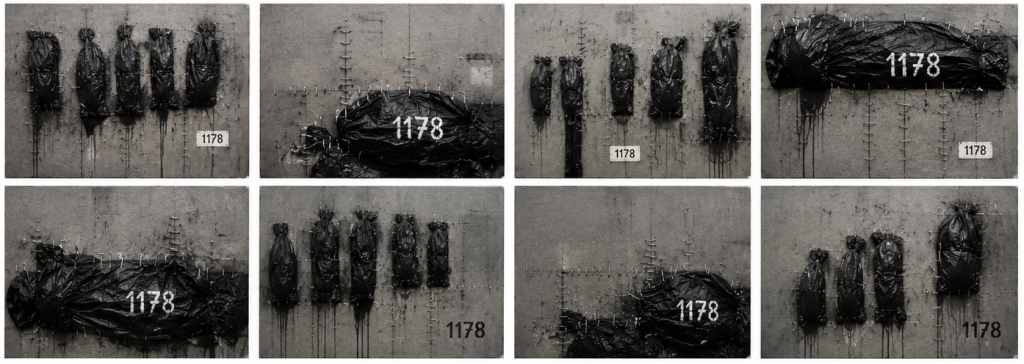
This mixed-media work was created in response to the people killed during the January 2026 violence in Iran and to the ways images of their bodies, names, numbers, and traces circulated through digital space. The work begins from the disturbing presence of black body covers, anonymous numbers, and fragmented images shared online. These images did not remain only as documentation of death. As they moved across social media, they became part of a collective struggle over recognition, grief, and political truth.
In this work, black plastic, staples, grey texture, stains, and repeated body-like forms are used to think through the material and digital life of suppressed bodies. The black plastic refers to covering, containment, disposal, and the forced reduction of the body to an anonymous object. The staples suggest both attachment and violence: they hold the forms in place, but they also pierce, fix, and immobilize them. The grey ground evokes a damaged surface: a wall, a floor, a public site, or an unstable archive on which traces of death are registered.
The number 1178 is not treated simply as a label. It stands for the bureaucratic and visual transformation of a dead body into a countable, searchable, and shareable sign. In the digital circulation of violence, numbers can both erase and preserve. They can reduce a life to data, but they can also become a point around which grief, anger, and public memory gather. The number becomes a fragile index of a person whose name, body, and story may be withheld, obscured, or violently managed.
This work is also an attempt to think about social media as a contemporary mourning space. In the aftermath of political violence, images of the dead often move faster than official recognition. Families, witnesses, activists, and ordinary users circulate fragments: a body, a number, a name, a post, a screenshot, a voice, a caption. These fragments produce a different kind of public archive—unstable, emotional, vulnerable, and collectively assembled. Digital circulation becomes one of the ways through which the dead continue to make claims on the living.
As part of my broader research on the agency of dead bodies and political mourning in Iran, this piece explores how suppressed bodies enter public life after death through both material and digital forms. The work does not attempt to reproduce the original images directly. Instead, it translates their force into texture, repetition, fixation, and surface. It asks how a body becomes a number, how a number becomes evidence, and how evidence becomes a site of mourning and resistance.
At the intersection of anthropology and mixed-media art, this piece treats visual material not only as documentation, but as a way of thinking. Through plastic, metal, texture, and number, it examines how political death is hidden, circulated, counted, and remembered.
January 2026 / Iran Mixed-media response to political death and digital circulation Black plastic, staples, acrylic, texture, stains, and numbered forms on canvas
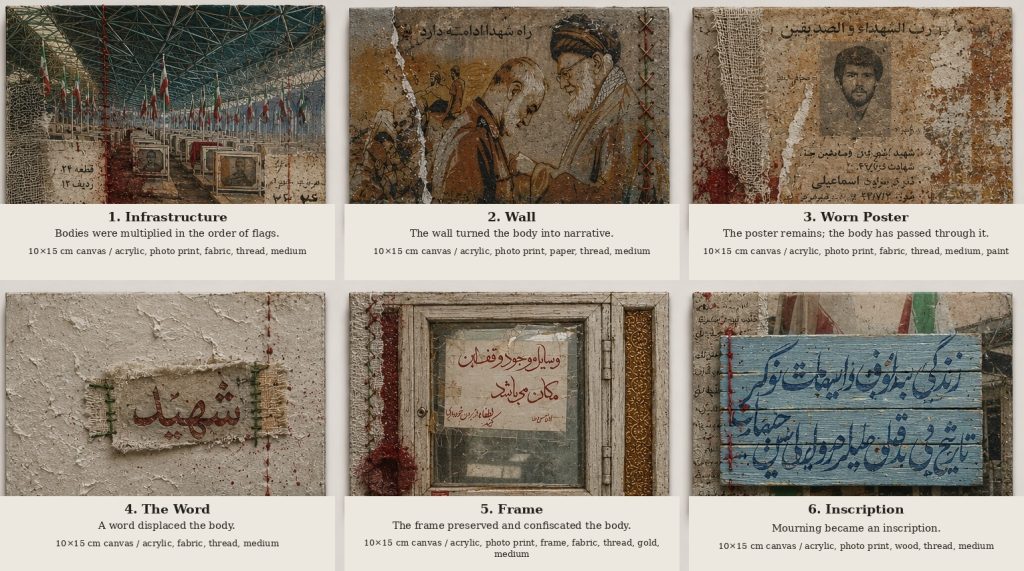
This series is based on photographs I took during my fieldwork in Iran in fall 2024 and spring 2025, in the cities of Ahvaz and Tehran. The photographs document urban spaces, walls, official signs, memorial frames, inscriptions, and sections of cemeteries, especially the martyrs’ sections.
This project is part of an ongoing attempt to bring together anthropology and visual art in order to think more carefully about political death in Iran. It is not only a finished visual series, but also a process of learning how to work with images, materials, and mixed-media techniques as part of anthropological research. Through this process, I am experimenting with how field photographs can be transformed into visual objects that carry texture, damage, repetition, inscription, and material presence.
As an anthropological project, the series approaches these images as part of a wider field of social and political life: cemeteries, city walls, portraits, flags, inscriptions, frames, ritual objects, and public memorial infrastructures. As a mixed-media art project, it works with the photographs as material fragments, layering them with texture, thread, fabric, stains, marks, paper, and written signs. The aim is not simply to illustrate death, but to explore how death is mediated, framed, touched, repeated, and made meaningful through visual and material forms.
In these images, the martyr’s body is not present only in the grave or in the portrait. Its presence extends through architecture, walls, frames, inscriptions, plaques, flags, and urban infrastructures. The city becomes a surface for preserving, repeating, and reproducing the name and image of the martyr. The cemetery, likewise, is not simply a place of burial; it is part of a visual, material, and political system that keeps the killed body within public memory.
This series is also concerned with the role of visual culture in how people come to understand political death. In Iran, martyrdom is not only a religious or political category; it is also a visual language. It is encountered through posters, murals, framed portraits, cemetery layouts, public signs, ritual objects, and repeated inscriptions. These visual forms teach people how to see the dead, how to remember them, and how to place them within larger narratives of sacrifice, legitimacy, nation, and political belonging.
By combining field photography with mixed-media interventions, this work asks what happens when ethnographic images are not treated only as documents, but also as materials to be worked through. The added textures, stitches, stains, and fragments do not attempt to reconstruct reality. Rather, they make visible the processes through which death becomes public, political, and aesthetically organized. They also allow me to think through the body, the image, and the city in ways that writing alone may not fully capture.
At the intersection of art and anthropology, this series asks how visual forms shape the social life of the dead. It treats images not only as evidence, but as active sites of interpretation and experimentation. Through this work, I am trying to understand how political death is displayed, governed, mourned, aestheticized, and made meaningful in contemporary Iran—and how visual art can open another way of thinking anthropologically about death, memory, and public life.
Fall 2024 / Spring 2025 Ahvaz and Tehran, Iran Urban spaces, walls, memorial images, and martyrs’ cemetery sections
My doctoral research is based on long-term ethnographic engagement with death, mourning, cemeteries, martyrdom, political violence, and material culture in Iran. In 2024, I conducted a multi-sited fieldwork project across several regions of the country, moving between borderlands, urban centres, cemeteries, museums, ritual sites, villages, war landscapes, and spaces shaped by political mourning.
This fieldwork included research in Arab Khuzestan, Kermanshah, Kurdistan, West Azerbaijan, Baluchistan, Tehran, Shiraz, Isfahan, and Shahin Shahr. Across these sites, I examined how death is mourned, governed, ritualized, remembered, and politicized through bodies, graves, laments, music, images, objects, ceremonies, and public space.
A major part of this research focused on local and vernacular mourning practices, especially women’s lamentation, Lur and Kurdish mourning traditions, Hurreh/Horeh singing in Kermanshah, Balochi lamentation and music, and forms of grief that circulate outside official institutions. I was especially interested in how women participate in mourning as ritual actors, narrators, singers, memory-keepers, and political subjects.
At the same time, I conducted fieldwork in more official and institutional sites of death, including Behesht-e Zahra cemetery in Tehran, museums related to death and martyrdom, national and religious ceremonies, 22 Bahman commemorations, and funerary events for unknown martyrs. This allowed me to compare local, familial, and vernacular forms of mourning with state-organized, ideological, and institutional forms of death management.
Together, these field sites form the empirical foundation of my doctoral project on the social and political agency of dead bodies in contemporary Iran. They allow me to trace how the dead continue to act through ritual, material culture, gendered mourning, burial spaces, public memory, and political contestation.
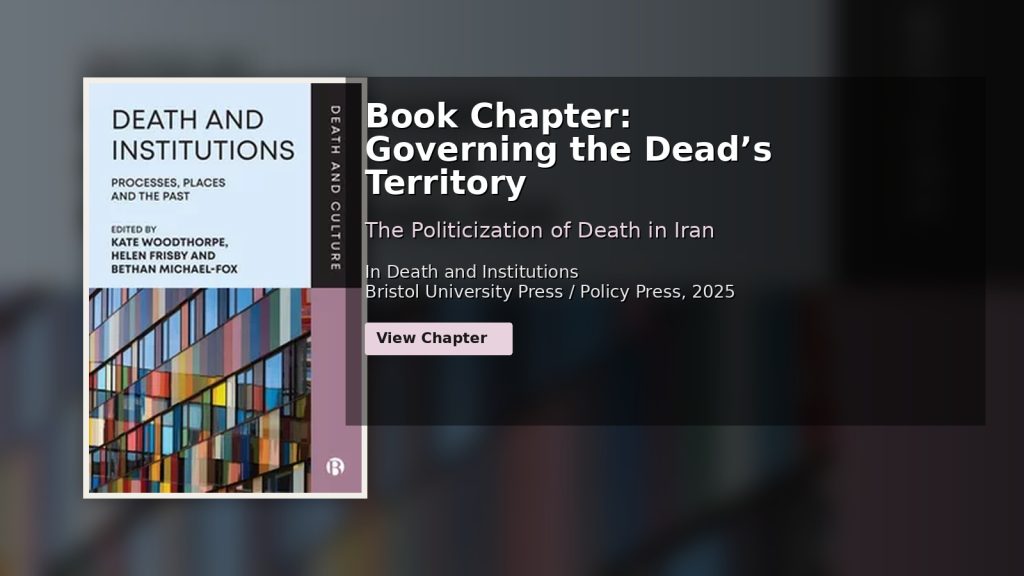
The Politicization of Death in Iran Hajar Ghorbani Published in Death and Institutions: Processes, Places and Past Bristol University Press / Policy Press, 2025
Governing the Dead’s Territory: The Politicization of Death in Iran examines Tehran’s Behesht-e Zahra cemetery as a major institutional space where death, burial, urban management, religious nationalism, and state power intersect in post-revolutionary Iran. The chapter asks how a cemetery can become more than a site of burial and mourning: how it can function as a governed territory through which the dead are classified, commemorated, organized, and incorporated into broader political narratives.
The chapter focuses on the transformation of Behesht-e Zahra into a large-scale municipal, ritual, and political institution. It considers how cemetery space, bureaucratic management, burial practices, martyrs’ sections, official ceremonies, and public memory contribute to the politicization of death in contemporary Iran.
This chapter is part of my broader research on death, mourning, material culture, political violence, and the social agency of dead bodies. It reflects my interest in how dead bodies and burial spaces continue to shape public life after death, generating forms of memory, obligation, legitimacy, and political meaning.
Publication Details
Chapter: “Governing the Dead’s Territory: The Politicization of Death in Iran” Author: Hajar Ghorbani Book: Death and Institutions: Processes, Places and Past Editors: Kate Woodthorpe, Helen Frisby, and Bethan Michael-Fox Publisher: Bristol University Press / Policy Press Publication date: February 28, 2025
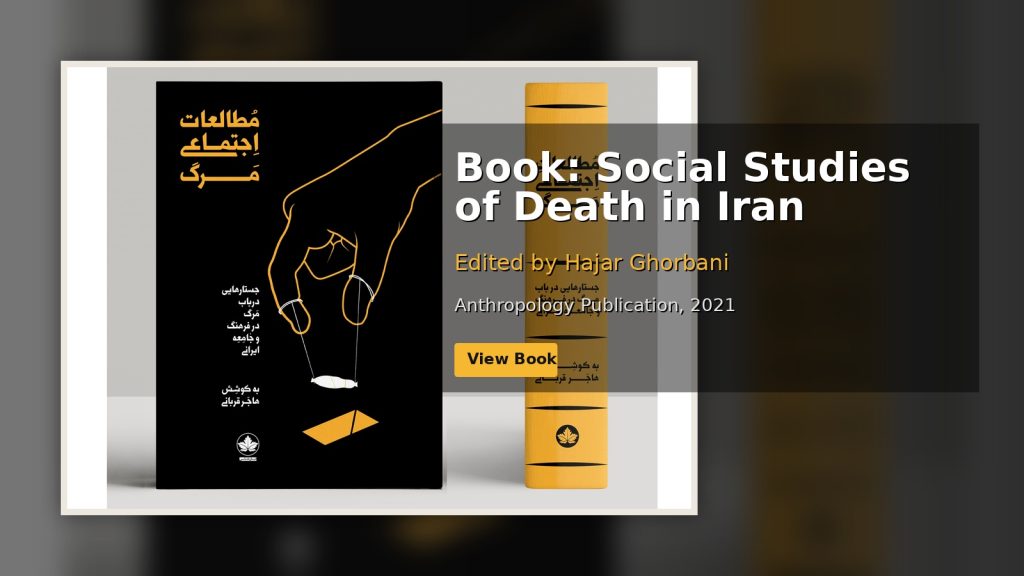
Edited by Hajar Ghorbani Anthropology Publication, 2021 Original Persian title: Motāleʿāt-e Ejtemāʿi-ye Marg: Jostārhāyi Darbāb-e Marg dar Farhang va Jāmeʿeh-ye Irāni Persian title: مطالعات اجتماعی مرگ: جستارهایی درباب مرگ در فرهنگ و جامعه ایرانی
Social Studies of Death in Iran is an edited volume in Persian, published by Anthropology Publication in 2021. The book brings together a group of scholars and writers to examine death, dying, mourning, burial, sacred death, medicalization, memory, art, literature, and cemetery spaces in Iranian society.
The volume was developed at a time when death studies had not yet been established as a recognized interdisciplinary field in Iran. Although death has long occupied a central place in Iranian religious, political, literary, and cultural life, it had rarely been approached as a sustained field of social inquiry. This book was therefore conceived as an attempt to open a space for interdisciplinary conversation around death and dying in Iran.
The book approaches death not as a merely biological event, but as a social, cultural, political, and material phenomenon. It asks how death is managed, symbolized, ritualized, medicalized, represented, and governed in Iranian society. It also considers how different historical periods, religious traditions, political transformations, urban institutions, medical systems, artistic forms, and literary representations have shaped the ways Iranians encounter death and mourning.
The volume is organized around several major themes: the social history of death, changing meanings of death, the medicalization of death, sacred death and martyrdom, representations of death in art and literature, and the emergence of large-scale cemetery spaces in Iran. Through these themes, the book introduces death as an interdisciplinary object of study and brings together perspectives from anthropology, sociology, history, philosophy, medicine, psychology, literature, art, and cultural studies.
A central concern of the volume is the place of death in modern and post-revolutionary Iran. The book examines how processes such as urbanization, state formation, medicalization, war, martyrdom, cemetery management, and the institutional organization of burial have transformed the social experience of death. In this sense, the volume does not treat death as a private or marginal matter. It shows how death is embedded in public life, political authority, religious meaning, family relations, urban space, and collective memory.
The section on sacred death and martyrdom is especially important for understanding the relationship between death and political life in Iran. The book situates martyrdom, war death, memorialization, and cemetery organization within the broader history of the post-revolutionary state. It pays attention to how the Iran-Iraq War, martyrs’ graves, funeral ceremonies, memorial policies, and cemetery landscapes have contributed to the political and cultural organization of death in contemporary Iran.
The volume also engages with the visual and material dimensions of death. Tombstones, cemeteries, memorial forms, artistic representations, literary images, and funerary spaces are treated as important sites through which death becomes visible and meaningful. This attention to material and visual culture connects the book to broader questions that continue to shape my own research: how the dead remain socially present, how material forms organize memory, and how bodies, graves, images, and objects participate in the making of social and political worlds.
For me, editing this volume was an important early step in developing death studies in relation to Iranian society. It brought together scholars from different disciplines and created a platform for thinking about death beyond a single theoretical or disciplinary framework. The project also shaped the trajectory of my later doctoral research on the agency of dead bodies, political mourning, martyrdom, cemeteries, and the politics of death in contemporary Iran.
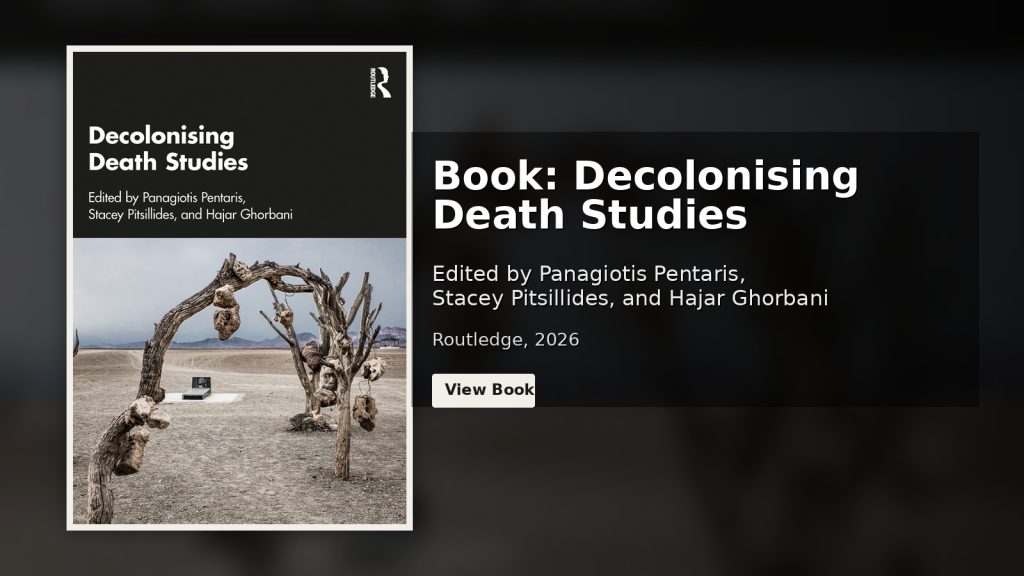
Edited by Panagiotis Pentaris, Stacey Pitsillides, and Hajar Ghorbani Routledge, 2026
Decolonising Death Studies brings together international and interdisciplinary perspectives that rethink death studies beyond primarily Western frameworks. The volume foregrounds decolonial, situated, and globally diverse approaches to death, dying, mourning, ritual, care, and end-of-life knowledge.
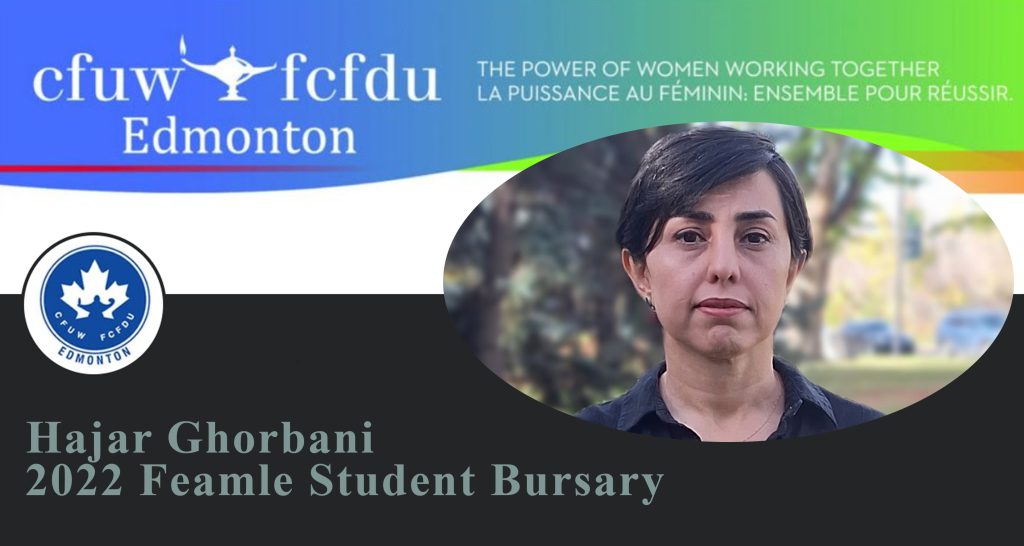
Hajar Ghorbani, a Ph.D. student of Anthropology, is one of the recipient of the CFUW bursary award at the University of Alberta.
CFUW Edmonton was founded in 1909 and is a non-partisan, voluntary, self-funded organization. Our membership is a community of women that have long history of successful efforts to improve the status of women at the local, provincial, national, and international levels and a commitment to continue those efforts today and into the future. Members are active in public affairs, work together for equality for women and girls, to raise the social, economic, political and legal status of women, as well as to improve education, the environment, peace, justice and human rights.