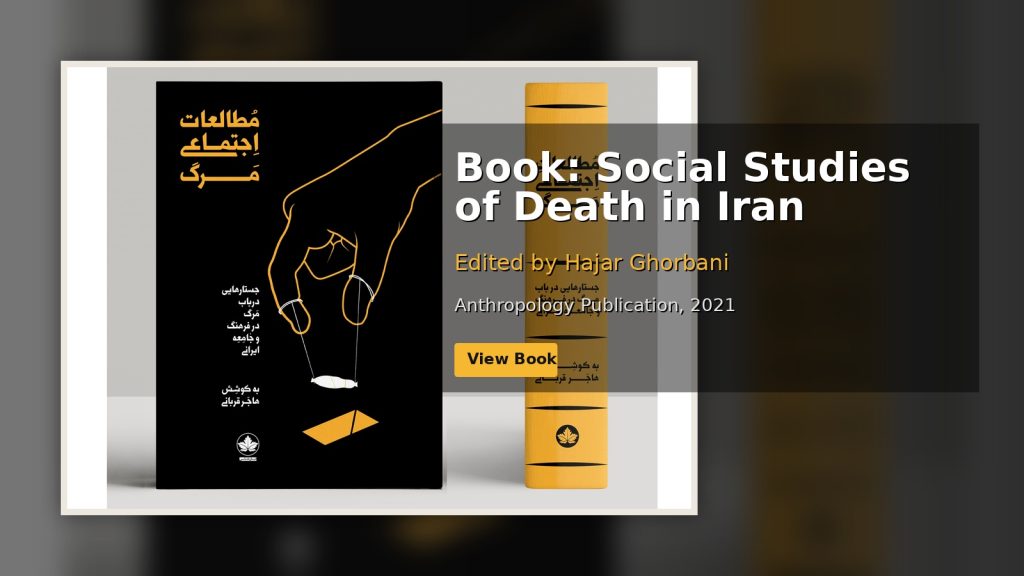
Edited by Hajar Ghorbani
Anthropology Publication, 2021
Original Persian title: Motāleʿāt-e Ejtemāʿi-ye Marg: Jostārhāyi Darbāb-e Marg dar Farhang va Jāmeʿeh-ye Irāni
Persian title: مطالعات اجتماعی مرگ: جستارهایی درباب مرگ در فرهنگ و جامعه ایرانی
Social Studies of Death in Iran is an edited volume in Persian, published by Anthropology Publication in 2021. The book brings together a group of scholars and writers to examine death, dying, mourning, burial, sacred death, medicalization, memory, art, literature, and cemetery spaces in Iranian society.
The volume was developed at a time when death studies had not yet been established as a recognized interdisciplinary field in Iran. Although death has long occupied a central place in Iranian religious, political, literary, and cultural life, it had rarely been approached as a sustained field of social inquiry. This book was therefore conceived as an attempt to open a space for interdisciplinary conversation around death and dying in Iran.
The book approaches death not as a merely biological event, but as a social, cultural, political, and material phenomenon. It asks how death is managed, symbolized, ritualized, medicalized, represented, and governed in Iranian society. It also considers how different historical periods, religious traditions, political transformations, urban institutions, medical systems, artistic forms, and literary representations have shaped the ways Iranians encounter death and mourning.
The volume is organized around several major themes: the social history of death, changing meanings of death, the medicalization of death, sacred death and martyrdom, representations of death in art and literature, and the emergence of large-scale cemetery spaces in Iran. Through these themes, the book introduces death as an interdisciplinary object of study and brings together perspectives from anthropology, sociology, history, philosophy, medicine, psychology, literature, art, and cultural studies.
A central concern of the volume is the place of death in modern and post-revolutionary Iran. The book examines how processes such as urbanization, state formation, medicalization, war, martyrdom, cemetery management, and the institutional organization of burial have transformed the social experience of death. In this sense, the volume does not treat death as a private or marginal matter. It shows how death is embedded in public life, political authority, religious meaning, family relations, urban space, and collective memory.
The section on sacred death and martyrdom is especially important for understanding the relationship between death and political life in Iran. The book situates martyrdom, war death, memorialization, and cemetery organization within the broader history of the post-revolutionary state. It pays attention to how the Iran-Iraq War, martyrs’ graves, funeral ceremonies, memorial policies, and cemetery landscapes have contributed to the political and cultural organization of death in contemporary Iran.
The volume also engages with the visual and material dimensions of death. Tombstones, cemeteries, memorial forms, artistic representations, literary images, and funerary spaces are treated as important sites through which death becomes visible and meaningful. This attention to material and visual culture connects the book to broader questions that continue to shape my own research: how the dead remain socially present, how material forms organize memory, and how bodies, graves, images, and objects participate in the making of social and political worlds.
For me, editing this volume was an important early step in developing death studies in relation to Iranian society. It brought together scholars from different disciplines and created a platform for thinking about death beyond a single theoretical or disciplinary framework. The project also shaped the trajectory of my later doctoral research on the agency of dead bodies, political mourning, martyrdom, cemeteries, and the politics of death in contemporary Iran.