Hajar Ghorbani is an Iranian scholar and pioneer in the field of death studies in Iran. She is an esteemed anthropologist and the founder of death studies in Iran. Hajar serves as the Iranian ambassador to the Association for the Study of Death and Society (ASDS). She has been recognized with prestigious awards in Canada, including the Izaak Walton Killam Memorial Scholarship at the University of Alberta and the Vanier Canada Graduate Scholarship, where she ranked first nationally. Hajar has published several influential papers and chapters on the study of death and dying in Iran and is the editor of the first volume dedicated to the social studies of death in Iran.
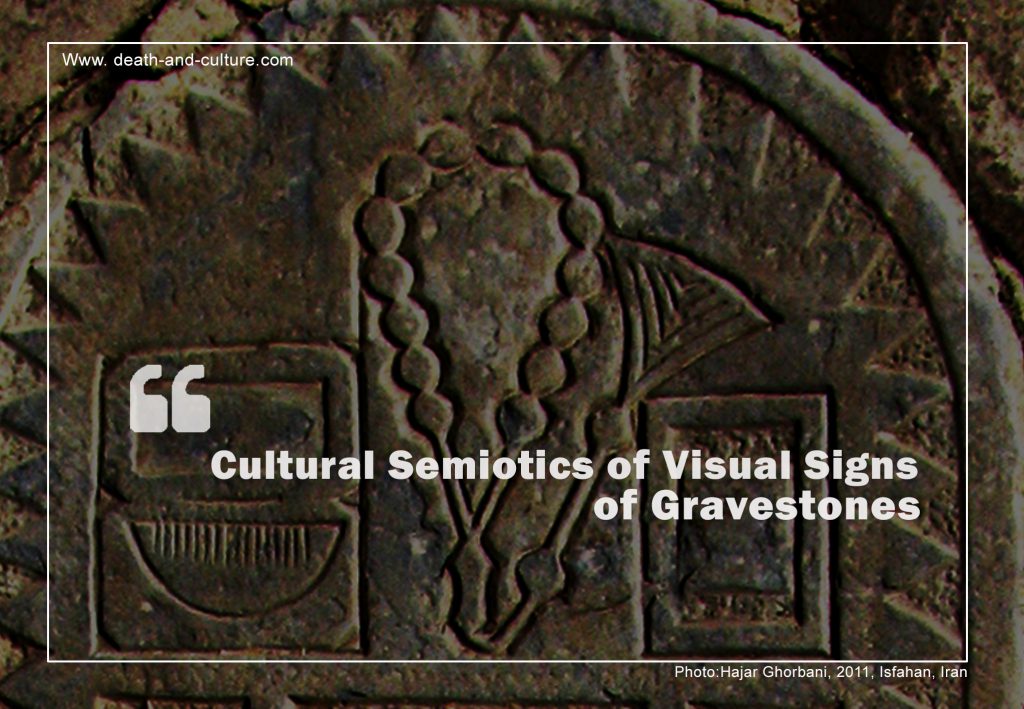
This paper (presentation) is a part of my fieldwork in Isfahan Takht-e Fulad cemetery in 2011.
The Takht-e Foulad cemetery is located in Isfahan and the south of Zayandeh-rood River. This cemetery took its power from the Safavid dynasty, which was a Shiite dynasty. [Azimi, 1379 AP., p.193]. The gravestones in Takht-e Fulad are of three kinds: horizontal or horizontal box and flat, mast and horizontal beside each other) Moreover, it is divided into two main parts (surrounded by Takaya and open.).
The signs on the gravestones in this cemetery can be divided into two signs, including visual signs and textual signs. By observing the pictorial and textual signs on the gravestones in the Takht-e fulad and interpreting them, what is revealed at first is that these signs express the job or profession of the deceased person. To find more precise meanings for these signs, we should find out the cultural relationship of these graphic patterns besides other signs on the gravestone. Combs are carved along with turbah, rosary, and some other signs, in some of the gravestones in this cemetery.
In the logic of determining the signs on the gravestones, the issue of being literate or illiterate in traditional culture is of great importance. So it seems in the era in which most people were illiterate. The text on the gravestone was a sign of the higher dignity of the deceased person, the best way to convey some information about the deceased person and his/her profession, and some other essential traits of that person, especially in the domain of religious values, was pictorial signs. In the past, signs like a wooden comb, rosary, and turbah were the distinguishing religious factors, and this was because of the presence of religious minorities in the city (Zoroastrians and Armenians).
This article is a part of my fieldwork at the Tehran’s Behesht-e Zahra cemetery from 2014-2015. I published another version of this idea in Persian in Iran in 2017. In the first version, I had a collaboration with Jabbar Rahmani, anthropologist, and this version I had a collaboration with Zohreh Bayatrizi, sociologist. The idea of these papers came to my mind during my fieldwork in the cemetery.
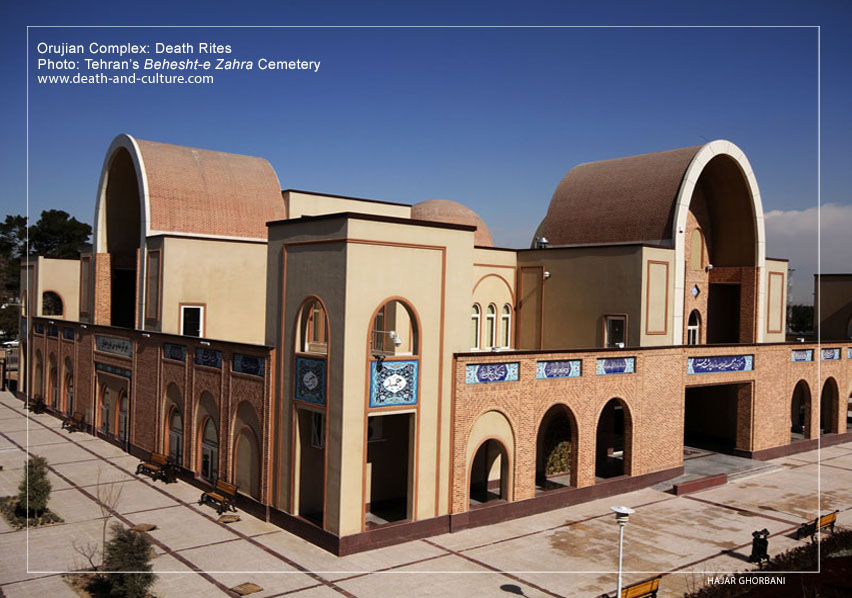
[…] Tehran’s current cemetery is called Behesht-e Zahra (literally, The Paradise of Zahra, named after Prophet Mohammad’s daughter) first opened on 314 ha of land in the southern outskirts of the city in 1970 in a bid to provide a permanent and centralized burial site for its rapidly growing population. Up until then local residents had buried their dead in one of the several graveyards within the city (Behesht-e Zahra, undated).1 Although at first the cemetery struggled to find a taker for its first grave, due to its distance from the city, lack of high-speed public transit, and scarcity of car ownership at the time, it now has over 1.5 million graves and has expanded to incorporate an additional 110 ha in 1997 and another 160 ha in 2009. The eight year war with Iraq (1980–1988) created a sharp rise in burials for the fallen soldiers who were buried in a dedicated parcel and gave the cemetery additional political and sentimental significance. A massive development project began in 1989 with the death of Ayatollah Khomeini, founder of the Islamic Republic, which led to the creation of a mausoleum and a major cultural, religious and tourist complex adjacent to the cemetery. With the expansion of car ownership and the extension of the subway line, the cemetery currently accommodates on average about 15,000 visitors per day with a major spike on the weekends. There are 164 lots in the cemetery, 18 of which are dedicated to the ‘martyrs’ and their parents, 3 to journalists, cultural and entertainment figures, and one to organ donors. These lots are located in prime spots in the older part of the cemetery, which are easier to access and highly sought after. The vast majority of the remaining lots are divided into one-, two-, and three-tier graves. One-tier graves in the new parts of the cemetery can be obtained free of charge. Multi-tired graves and graves in more desirable plots are up for sale.
Up until 1991, the cemetery had one building, which was a dedicated ablution (ritual washing and purification) facility. In that year, the Behesht-e Zahra Organization was officially created and a building built using Iranian and Islamic architectural motifs to house the morgue, ablution facility, reception, registration, banking and other bureaucratic offices. Although Behesht-e Zahra is officially run by the City of Tehran, it was forced to become financially self-sufficient in 1993 with revenues generated through fees for burial services as well as the sale of family mausoleums and multi-level graves, surcharges for burials in the older parcels, and renting out commercial space for flower shops, headstone shops, and other related services (Behesht-e Zahra, undated).
As a result of the above developments, the Behesht-e Zahra Organization has expanded rapidly, creating various bureaucratic arms to cope with a variety of tasks from the daily handling of bodies, to ongoing maintenance, event planning for special occasions (prime among them the anniversary of Ayatollah Khomeini’s death every June), human resources management, and long term strategic planning. Here we will focus only on the professionalization and bureaucratization of the funeral rituals, that is the handling of the body from when it arrives at the cemetery until it has been buried, including corpse washing, wrapping, prayers, graveside rites, and burial.
Mourning with the world: The loneliness of grief in a pandemic
Zohreh, Bayatrizi, Hajar Ghorbani and Reza Taslimitehrani
[…] In the case of COVID-19 deaths, we see these dynamics at play again on local, national and transnational scales. The emerging evidence in Iran indicates that contagion both as a biological fact but also as a social fear and stigma might have led to the increasing loneliness and even stigmatization of the dying and the grieving relatives. In personal interviews, survivors identified separation from the dying and dead relatives as the worst aspect of grief during contagion. A woman who had managed to slip into the ICU room and seen her father for a last time before he died was deeply distraught by the memory of her father’s loneliness. Her distress was renewed with the loneliness of his funeral:
They didn’t let us get close. We were at a distance, struggling to contain ourselves. They didn’t show us his face one last time. We didn’t see it. And my sister says . . . she cannot believe that it was him that they put in the grave. This type of departure, this estrangement, adds to our sorrows. In his last days he was awaiting us in the hospital, alone. . . . I constantly wonder how he must have expected us to visit him. I hope he knows our regret. I always think only if they had shown me his face. My dad’s face. . . . (SZ, April 2020)
Another young woman who lost her grandfather during the pandemic talked about the lingering pain of the lonely funeral:
The cemetery was terrible. Our family is very attached to each other. But we had no one there. . . . Even now my father and uncle complain about the loneliness of it. . . . I’m certain that none of us has accepted it yet because the usual ceremonies were not held, we didn’t go to the mosque and no one was there for the burial, except for us (RK, April 2020)
The lack of physical contact compounded the loneliness for mourners, a fact that is not surprising especially given that grief is an embodied and relational experience (McCarthy and Prokhovnik, 2014):
The loneliness is one thing, the absence of a shoulder to cry on. The worst part of it is that you cannot hold your loved ones. The lack of physical interaction causes the most damage. (AJ, April 2020)
The fear of biological contagion clashed with the social norms of collective mourning in Iran, where families and friends gather around the bereaved for days and where it is deemed cruel to leave them alone. Where mourning ceremonies have traditionally been an occasion for coming together and setting difference aside, the fear of contagion drove some families apart. One interviewee who had lost his brother took offence to the fact that some of their close relatives had shunned them for fear of the virus: ‘My uncle’s family had a banner of condolence made and posted outside our door when we were asleep at home. They didn’t even bother to ring the bell and speak with us from a distance.’ Conversely, a young woman was cut off by her sister’s family after she refused to visit them at home and in-person out of concern for contracting the virus (for more on the family dynamics of disease, see Sobel and Cowan, 2003).
My path into anthropology began through art. Before I entered the social sciences, I was trained as an artist, with an early focus on design and visual-material practice. My undergraduate education gave me a broad and technically grounded formation in making, drawing, painting, woodworking, sculpture, installation, and object design. This training was not limited to the production of images. It was also an education in material, surface, form, weight, texture, proportion, and the relation between objects and space.
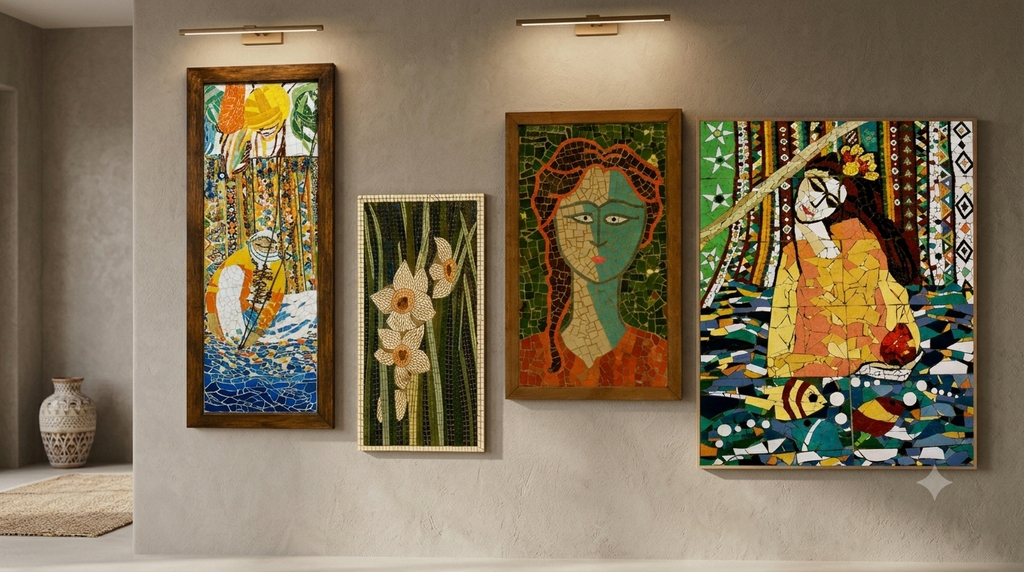
During my undergraduate studies, I worked extensively with wood and learned several traditional and technical methods, including marquetry, khatam, woodcarving, sculpture, box-making, frame-making, and object construction. I was also trained in aspects of industrial design, including the design and fabrication of tools, frames, boxes, and display structures. I became interested in geometric forms associated with Islamic architecture, especially girih and lattice-based compositions, where repetition, precision, structure, and ornament produce both visual and spatial effects. Alongside these practices, I also worked with resin and other material techniques that allowed me to think more experimentally about surface, transparency, layering, and preservation.
My painting and drawing practice developed in parallel with this material training. I worked with colored pencil, chalk pastel, graphite, different pencil-based techniques, and ink. Chalk pastel became especially important in my early practice because of its softness, density, and capacity to hold both fragility and intensity on the surface. I was particularly interested in portraiture, the human face, texture, and the expressive force of line and color. This interest led to my solo painting exhibition in Kerman, titled Portraits, in which I primarily used chalk pastel.
Installation art was another important part of my artistic formation. During my undergraduate studies, I created two installation-based projects that combined sculpture, music, spatial arrangement, and conceptual research. One installation engaged Mesopotamian mythologies and the agency of great goddesses. Through sculpture and spatial composition, I explored how female divine figures could be imagined not simply as mythological subjects, but as agents whose presence, form, and material arrangement shaped the viewer’s encounter with the work.
The second installation was more directly connected to death, memory, gender, and Iranian culture. I constructed six wooden tombstones dedicated to six influential women in Iranian cultural history. The work combined carved or constructed wooden forms with music and installation-based presentation. Looking back, this project was one of my earliest attempts to think about the relationship between the dead, material objects, commemoration, gendered memory, and public recognition. Even before I had the full anthropological language for these questions, I was already working with themes that later became central to my academic research: tombstones, memory, gender, material presence, and the agency of commemorative forms.
This artistic background profoundly shaped the way I later approached anthropology. Art trained me to look slowly and materially. It taught me to notice how objects are made, how surfaces carry traces, how forms organize attention, and how images and materials produce encounters. When I later began studying cemeteries, tombstones, martyr graves, photographs, coffins, portraits, ritual objects, and memorial spaces, I did not approach them only as symbolic materials or cultural data. I approached them as visual and material forms that act within social life. My artistic training allowed me to see how material cultures can shape memory, produce obligation, organize mourning, and mediate relations between the living and the dead.
In my undergraduate and master’s research, this connection between art and anthropology became more explicit. I became increasingly interested in the visual elements of cemeteries, especially martyr cemeteries, and in the material culture that surrounds death and commemoration. I studied tombstones, inscriptions, portraits, symbols, colors, spatial arrangements, objects placed on graves, and the aesthetic organization of funerary spaces. These materials allowed me to bring together visual analysis, semiotics, material culture, and anthropological questions about death, memory, religion, gender, and political meaning.
Today, this visual-material orientation continues to shape both my scholarship and my creative practice. My doctoral research on the agency of dead bodies in contemporary Iran is grounded not only in ethnographic fieldwork, but also in close attention to bodies, images, textures, graves, objects, spatial arrangements, and ritual forms. Alongside academic writing, I continue to develop mixed-media work that brings together photography, painting, texture, collage, and material experimentation. I am also interested in filmmaking and documentary practice as ways of extending anthropological thinking beyond written scholarship.
I was born in Shiraz, Iran, in a large family. My early path into art was shaped by both desire and resistance. Although I was deeply drawn to art, my father initially opposed my decision to attend an art school. As a result, my education took an unconventional form. For several years, I stepped outside the formal school system and used that period to explore different practices, especially drawing, painting, and martial arts. I trained in Kung Fu, participated in competitions, and continued to develop my skills in painting, particularly with chalk pastel. This period was difficult, but it also shaped my independence, discipline, and capacity for self-directed learning.
After several years, I persuaded my father to allow me to take the entrance exam for an art program. I was eventually admitted to the Islamic Art program at Isfahan University of Art. Moving from Shiraz to Isfahan was a major turning point in my life. It was not only a move from one city to another; it was my first serious encounter with a new intellectual, artistic, and urban environment. Isfahan itself became part of my education. I began to walk through the city, observe its architecture, photograph its streets and objects, and experience urban space as something that could be read, interpreted, and analyzed.
At Isfahan University of Art, I studied in the Department of Religious and Civilization Arts. The department created an unusual intellectual environment where art was not approached only as technique, beauty, or form, but also as a way of thinking about culture, history, religion, society, and meaning. Between 2009 and 2013, I encountered scholars from anthropology, sociology, philosophy, semiotics, mythology, and art history. Their courses and conversations introduced me to new ways of understanding visual and material culture.
A decisive moment came when I took a course in the anthropology of art. This course changed the way I looked at the world around me. The concept of culture became central to my thinking. I began to understand that objects, images, rituals, spaces, and everyday practices could be studied as part of wider social worlds. My artistic practice of looking, drawing, and photographing gradually became connected to anthropological observation. I was no longer only interested in how things looked, but also in what they did, what they meant, and how they organized relations between people, places, memories, and histories.
During this period, I often walked through Isfahan with my camera. One day, by chance, I came across Takht-e-Fulad, a historic cemetery in the city. The tombstones immediately caught my attention. Their forms, inscriptions, symbols, materials, and visual arrangements seemed to hold complex cultural meanings. I photographed them and later discussed the images with Jabbar Rahmani, an anthropologist in our department. He encouraged me to think of tombstones as cultural texts and suggested that I explore the anthropology of death, a field that was still relatively underdeveloped in Iran at the time.
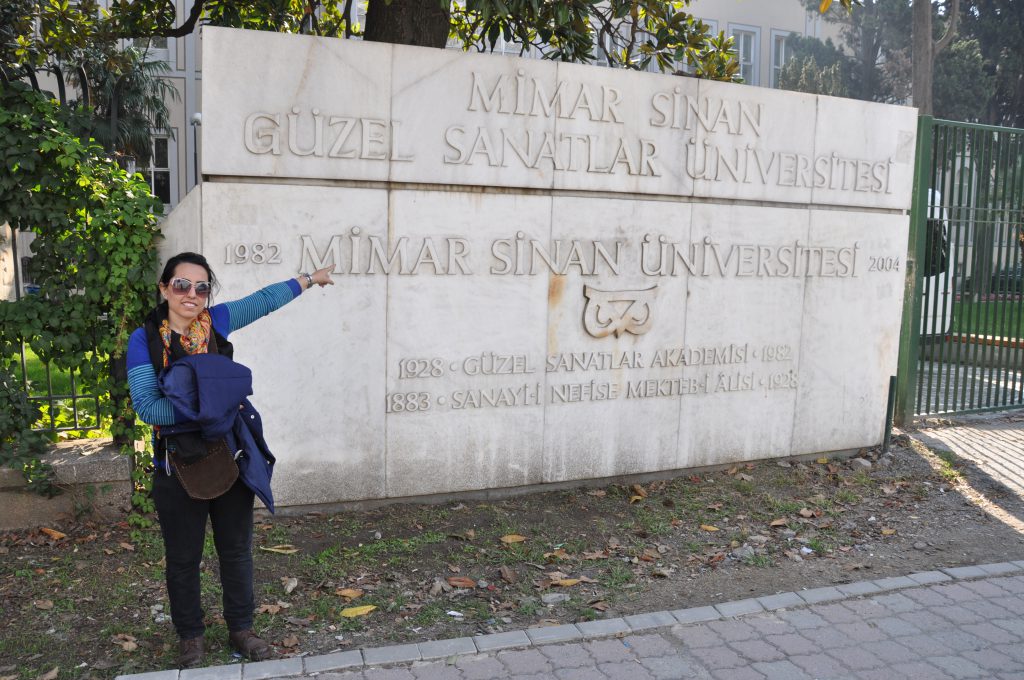
This encounter became the foundation of my undergraduate thesis, “Cultural Semiotics of Tombstone Signs in the Takht-e-Fulad Cemetery.” The project allowed me to bring together my artistic training and my emerging anthropological interests. Tombstones were no longer simply visual or decorative objects. They became material forms through which death, memory, religion, gender, class, and cultural identity could be read and interpreted. Based on this work, I later published an article and presented my research at an international conference in Turkey in 2013.
This movement from Shiraz to Isfahan, and from art to anthropology, continues to shape my work today. My research on death, cemeteries, martyrdom, mourning, and the agency of dead bodies grew out of this early encounter between visual practice and anthropological thinking. Art trained me to attend to form, texture, composition, and material presence. Anthropology gave me the conceptual tools to connect those forms to social life, ritual, memory, power, and political meaning.